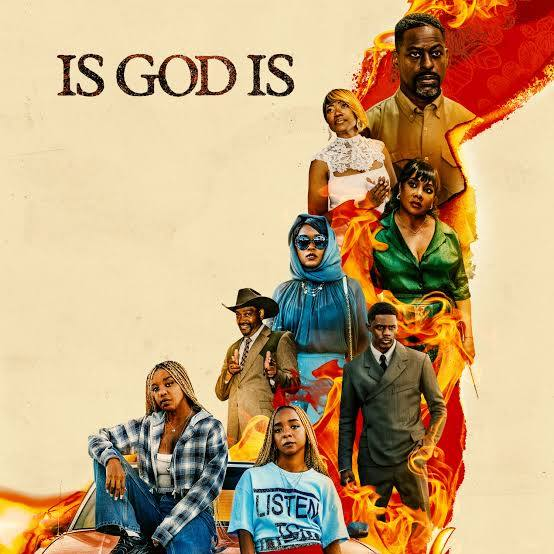
I’ll be transparent: I went into Is God Is knowing almost nothing about it. The preview suggested a revenge film. Two women with a score to settle. That was enough for me. I didn’t read the synopsis. I didn’t know it was adapted from an Obie Award-winning Off-Broadway play. I didn’t know this was writer-director Aleshea Harris’s feature debut. I just knew the trailer had me, and that was sufficient.
What I was not prepared for was how universal the film would feel. And I mean that as the highest possible compliment — because in this industry, “universal” is a word that gets wielded like a weapon against stories featuring Black casts. Studios use it as a gatekeeper. Is this universal enough? Translation: Will white audiences show up? It is one of the most cynical calculations in the business, and it has quietly killed or diminished more good work than we will ever fully know.
Is God Is is the film that exposes that gatekeeping for exactly what it is: lazy, limiting, and frankly embarrassing.
“This story could be set anywhere. It could be any family, any ethnicity, any landscape. The specifics of its world don’t narrow it — they make it feel more true.”
What the Film Actually Is
Twin sisters — Racine and Anaia, played with fierce precision by Kara Young and Mallori Johnson — are summoned to the deathbed of their mother, Ruby, a woman they haven’t seen since childhood. Ruby, burned beyond recognition by their father, tells them she calls herself God now. And she has one final commandment: find your father. Make sure he dies.
What follows is part road trip, part Greek tragedy, part grindhouse revenge thriller — styled with what critics are calling Afropunk visual sensibilities, but what I’d simply call a bold and singular cinematic voice. Sterling K. Brown plays the father, billed only as “The Monster,” and he is — quietly, terrifyingly, without an ounce of scenery-chewing — exactly that. The cast around him reads like someone assembled a dream team and then actually got them all to say yes.
Director & Writer Aleshea Harris
Producer Tessa Thompson
Racine Kara Young
Anaia Mallori Johnson
The Monster Sterling K. Brown
Also starring Janelle Monáe, Vivica A. Fox, Erika Alexander, Mykelti Williamson
This film is backed by Amazon MGM through Orion Pictures, produced in part by Tessa Thompson, and adapted from Harris’s own play. It is not a scrappy indie that somehow slipped through. Somebody looked at this material, understood what it was, and greenlit it with the cast and resources it deserved. For that alone, they deserve genuine credit. In an industry that still argues over whether revenge narratives fronted by Black women can carry a wide release, getting this film made at this scale is not nothing. It is actually something.
The “Black Film” Box and Why It Needs to Burn
Here is what I kept thinking as I watched: if you swapped the cast with any other ethnicity and moved the setting to rural Greece, or the American Southwest, or the Scottish Highlands, critics would be calling it a masterwork of mythological storytelling. They would be drawing lines to Tarantino. They would be calling Harris a visionary — which, for the record, she is — without the caveat of “in the Black cinema space.”
The story at the center of Is God Is is primal and ancient and belongs to everyone: a mother destroyed by a man she loved, daughters left to carry wounds they didn’t choose, a system that failed to protect any of them, and a reckoning that the law refused to deliver. These are not Black themes. These are human themes. They have been human themes since Medea. They will be human themes long after we’re done arguing about box office demographics.
“The ‘Black film’ category isn’t a celebration. It’s a smaller room. And some filmmakers are making work too large to fit inside it.”
Good for Them. Now Do More of This.
I don’t say “good for them” lightly. I say it as someone who works in this industry and knows exactly how many versions of this conversation happen in rooms where decisions get made — where a project like this gets quietly redirected toward a smaller platform, a smaller budget, a smaller opening, a smaller conversation. Where “is it universal?” is asked not as a genuine creative question but as a coded one.
Somebody asked that question about Is God Is and answered it correctly: yes, it is universal, because great storytelling always is, and the ethnicity of the characters is not a ceiling on the story’s reach — it is simply the specific and fully realized world the story inhabits. That is how it has always worked with every other group. It should work that way here too.
Go see this film. Take someone who wouldn’t normally pick it. Watch what happens when a story this well-told reaches someone who thought it wasn’t for them. Because it is. That’s the whole point.


Leave a Reply